
FinTech SaaS SEO:
FinTech SaaS SEO - Organic Growth for Payments, Lending, and Financial Software Companies
FinTech buyers are among the most compliance-conscious and risk-averse in B2B. A generic SEO strategy that ignores YMYL standards, regulatory terminology, and the trust signals financial decision-makers require will not rank well and will not convert. We build FinTech SEO strategies that satisfy Google’s quality standards for financial content and the evaluation criteria of CFOs, compliance teams, and procurement officers.
Categories
Payments, Lending, Neobanking, Treasury, Embedded Finance, RegTech, WealthTech
YMYL
compliant content strategy built for financial industry E-E-A-T requirements
BOFU comparison
comparison, alternative, and compliance-driven keyword strategy
Organic CAC
n FinTech runs 47% lower than paid on average
Why FinTech SEO Fails Without Specialist Knowledge
FinTech sits inside Google’s Your Money or Your Life category. Content that makes unsubstantiated claims about financial products, quotes rates without proper disclaimers, or uses regulatory terminology incorrectly creates compliance exposure and gets suppressed in rankings. Most general SEO agencies are not equipped to navigate this. The result is content that either fails to rank because it lacks the E-E-A-T signals Google requires for financial content, or content that creates legal risk because the writers did not understand what they were writing about.
The buyer journey compounds the problem. A CFO evaluating a B2B payments platform or a treasury management tool is not going to convert from a single blog post. FinTech purchase decisions involve compliance teams assessing regulatory risk, IT evaluating security architecture, and finance leadership building a business case. These stakeholders search using different terminology: PCI DSS, SOC 2, PSD2, open banking APIs, embedded lending, multi-currency settlement. Generic SEO strategies that ignore this vocabulary miss the buyers who are closest to a decision.
Trust signals carry more weight in FinTech than in almost any other SaaS category. Buyers are being asked to trust a vendor with financial data, payment infrastructure, or compliance reporting. Your organic content has to communicate that your platform is credible, secure, and compliant before a buyer will request a demo. Content that reads like generic marketing copy fails this test immediately with financial decision-makers.
We build FinTech SEO strategies that reflect how financial buyers actually evaluate software: through compliance-specific searches, peer reviews, regulatory framework alignment, and careful vendor comparison.
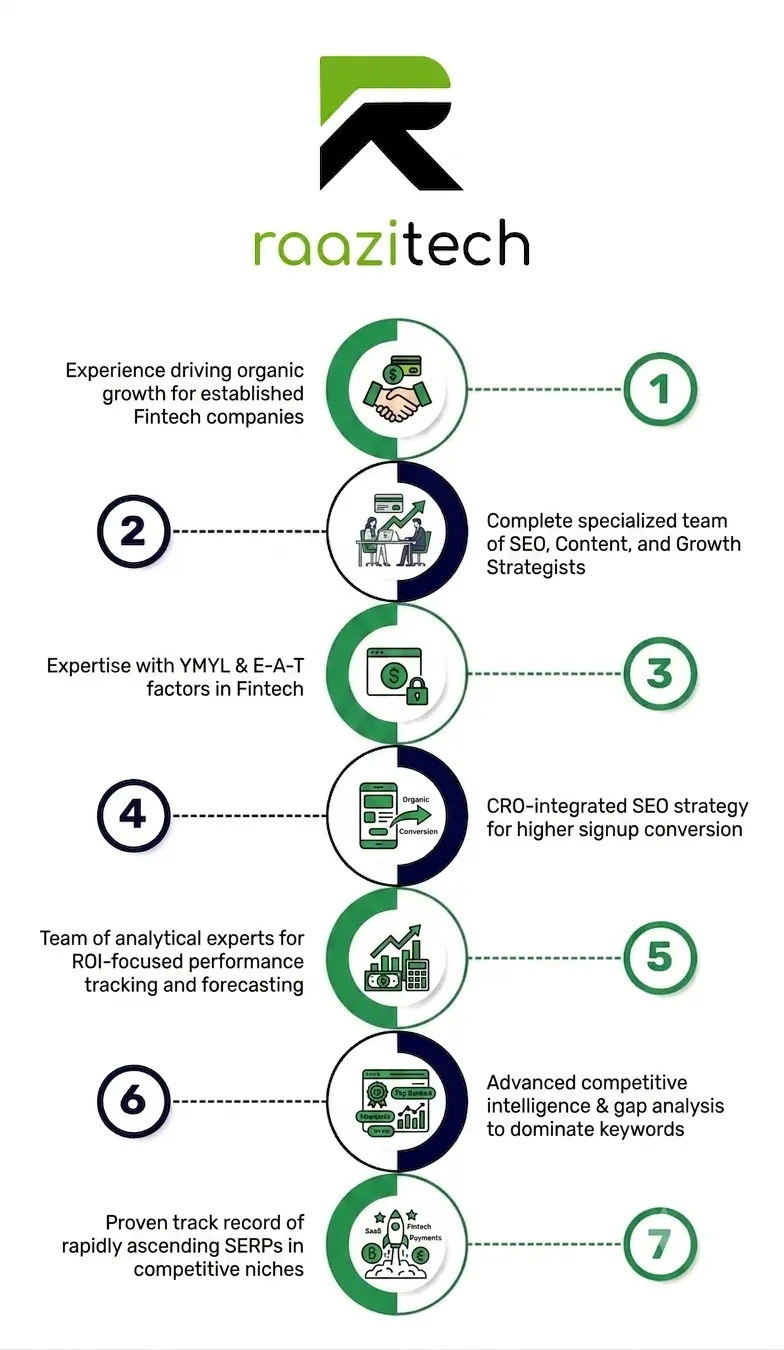
Why FinTech SEO Is Different from Standard SaaS SEO
YMYL Changes the Ranking Rules
In most SaaS categories, well-written content with good backlinks ranks. In FinTech, Google’s YMYL classification means content must also demonstrate expertise, authoritativeness, and trustworthiness from recognizable, credible sources before it earns high rankings. This is not a technicality. It is the most common reason well-produced FinTech content fails to rank despite significant investment.
The Compliance Layer Is a Competitive Advantage
Most FinTech companies treat compliance as a legal requirement and ignore it as a marketing asset. Buyers searching for payment compliance software, SOC 2 certified lending platforms, or GDPR-compliant financial APIs convert at significantly higher rates than buyers searching for generic FinTech tools. Compliance-driven content is high-intent content, and most FinTech companies are not producing it effectively.
Financial Buyers Are Skeptical by Profession
CFOs and compliance officers are trained to identify risk and evaluate claims critically. Marketing language that overstates capabilities, makes vague security claims, or uses regulatory terms loosely damages credibility immediately with this audience. FinTech SEO content must be precise, verifiable, and conservative in its claims to earn the trust of buyers who will scrutinize every word before approving a vendor relationship.
What Our FinTech SaaS SEO Service Covers
FinTech SEO requires the same core disciplines as any SaaS vertical, applied through the lens of regulatory compliance, high-stakes trust requirements, and a buyer journey that involves multiple financial and technical stakeholders.
YMYL Compliance and E-E-A-T Architecture
01.
Google classifies financial content as Your Money or Your Life, meaning the quality bar is substantially higher than for standard SaaS content. Author credentials must be visible and verifiable. Regulatory claims must be accurate and properly qualified. Company information must be transparent and consistent with third-party sources. Trust signals such as PCI DSS certification, SOC 2 status, and regulatory authorization badges need to appear in the right context on the right pages. We build the content architecture and on-page signals that satisfy these requirements, which is the prerequisite for ranking in FinTech before any other SEO work produces results.
Regulatory and Compliance Keyword Strategy
02.
FinTech buyers search using the specific regulatory frameworks relevant to their industry and jurisdiction. Payment companies search for PCI DSS compliance tools. Lenders search for consumer lending compliance software. Finance teams at regulated institutions search for SOC 2 Type II certified platforms. GDPR and PSD2 generate significant search volume in European fintech markets. We map your compliance capabilities to the specific regulatory search terms your buyers use, building content that addresses these queries directly and converts compliance-aware buyers who are specifically looking for what you offer.
Comparison and Alternative Pages for the HR Tech Landscape
03.
The HR tech market has more named, well-known competitors
than most SaaS categories. Buyers actively search for your product against
specific competitors and for alternatives to category leaders. We build
comparison pages that address these searches directly with honest feature
breakdowns, pricing context, and clear positioning for the buyer profile each
page targets. These pages are revisited multiple times during a typical HR
software evaluation, making them some of the highest-leverage content in the
category.
Comparison and Alternative Pages for Financial Software
04.
Comparison keywords in FinTech convert at four to eight times the rate of informational content because the buyer is already in evaluation mode. A B2B payments company ranking for an embedded finance platform comparison captures buyers who have already decided to invest in a solution and are selecting a vendor. We build comparison pages that address the specific competitors your buyers evaluate, with accurate feature breakdowns, pricing context, and clear positioning that helps compliance-aware buyers make a confident decision.
Vertical and Use-Case Page Strategy
05.
FinTech is not a single market. Payments, lending, wealth management, embedded finance, insurance technology, and regulatory compliance software all have distinct buyer profiles, search behaviors, and competitive landscapes. We build dedicated vertical and use-case pages targeting the specific FinTech sub-category your platform serves, capturing high-intent traffic from buyers who search with category-specific language rather than generic financial software terms.
Trust Signal Optimization
06.
FinTech buyers revisit vendor websites multiple times during evaluation, checking security certifications, regulatory status, audit reports, and client references before requesting a demo. We optimize the placement and presentation of your trust signals across the pages buyers land on during their research, ensuring that every compliance certification, security audit result, and regulatory authorization is visible, credible, and positioned at the points where trust concerns are most likely to slow or stop an evaluation.
AI Search Visibility for FinTech
07.
FinTech buyers increasingly use AI tools to generate initial vendor shortlists before visiting any website. Content that is structured for AI extraction, properly cited, and demonstrably accurate on regulatory claims is significantly more likely to be cited in AI-generated answers for financial software queries. We build these signals into every piece of content and optimize existing pages for AI search visibility alongside traditional organic rankings.
What You Receive
Every FinTech engagement begins with a compliance content audit and E-E-A-T gap analysis before any production starts.
Vertical and use-case page plan for the specific FinTech markets your platform serves
AI search visibility optimization for financial software comparison and recommendation queries
E-E-A-T and YMYL compliance audit with author credibility, regulatory claim accuracy, and trust signal gaps identified
Regulatory keyword research mapped to your specific FinTech sub-category and the compliance frameworks your buyers search for
Comparison and alternative page strategy targeting named competitors in your financial software category
Content briefs and written content with regulatory accuracy review built into the production process
Trust signal optimization plan for security certifications, regulatory status, and compliance documentation
Ready to start?
Book a free 30-minute discovery call
Frequently Asked Questions
What makes FinTech SEO different from standard SaaS SEO?
FinTech sits inside Google’s Your Money or Your Life category, which applies stricter quality standards for expertise, authoritativeness, and trustworthiness than standard SaaS content. Regulatory terminology must be accurate, author credentials must be visible and credible, and trust signals including security certifications and compliance status must be properly presented. Beyond the ranking requirements, FinTech buyers are compliance-conscious professionals who evaluate vendor content critically before trusting any organization with financial data or payment infrastructure.
Do you work with B2B FinTech companies only or also B2C?
We work primarily with B2B FinTech SaaS companies including payment platforms, lending software, treasury management tools, embedded finance infrastructure, RegTech platforms, and financial analytics tools. The buyer journey, keyword strategy, and content requirements differ significantly between B2B and B2C financial products, and our methodology is built around B2B evaluation cycles with multiple stakeholders.
How do you handle compliance in the content you produce?
We work primarily with B2B FinTech SaaS companies including payment platforms, lending software, treasury management tools, embedded finance infrastructure, RegTech platforms, and financial analytics tools. The buyer journey, keyword strategy, and content requirements differ significantly between B2B and B2C financial products, and our methodology is built around B2B evaluation cycles with multiple stakeholders.
Which FinTech sub-categories do you work with?
We work across the FinTech spectrum including payments and payment orchestration, lending and credit software, neobanking and digital banking infrastructure, embedded finance platforms, treasury and cash management tools, RegTech and compliance automation, wealth management and investment platforms, and insurance technology. Each sub-category has distinct buyer search behavior, regulatory considerations, and competitive dynamics that the strategy addresses specifically.
How long does FinTech SEO take to produce results?
FinTech SEO typically takes longer to produce measurable ranking movement than standard SaaS SEO due to the YMYL classification and the trust-building requirements that Google applies to financial content. Expect 12 to 18 months before organic search becomes a significant and consistent growth channel for competitive FinTech keywords. BOFU comparison and alternative pages targeting lower-competition queries can show ranking movement within 6 to 10 weeks. The extended timeline reflects the compounding authority-building required, not any flaw in execution.
Can you help with international FinTech SEO across multiple regulatory jurisdictions?
Yes. FinTech is increasingly global, and search behavior, regulatory vocabulary, and compliance requirements differ significantly between the United States, United Kingdom, European Union, and Asia-Pacific markets. We build jurisdiction-specific content strategies that address the regulatory frameworks relevant to each market, using the terminology financial buyers in each region use when searching for solutions that meet their local compliance requirements.