
EdTech SaaS SEO :
EdTech SaaS SEO Organic Growth for LMS, K-12, Higher Education, and Corporate L&D Companies
EdTech procurement is fundamentally different from standard SaaS buying. School districts run committee-based evaluations aligned to academic budget cycles. Universities involve faculty, IT governance, and administrative leadership in parallel. Corporate L&D buyers evaluate platforms against workforce development priorities and training ROI. Generic SEO does not account for any of this. We build organic strategies specifically around how education institutions and corporate learning teams research and select software.
Segments
K-12, Higher Education, Corporate L&D, Workforce Learning, Assessment, Student Information Systems
Seasonal buying cycle alignment
budget windows, procurement seasons, and academic calendars
Multi-stakeholder content
Administrators, IT Directors, Faculty, Finance, and L&D Leaders
Institutional procurement cycles
committee decisions, pilot programs, and board approvals
Why EdTech SEO Fails Without Institutional Procurement Knowledge
EdTech buying is not a single buyer making a software decision. A K-12 district procurement involves superintendents, curriculum directors, IT administrators, finance officers, and frequently a board vote. A university LMS selection involves faculty committees, an IT governance process, accessibility compliance review, and administrative leadership alignment. A corporate L&D platform decision involves the CHRO, L&D directors, IT security, and finance. Generic SaaS content that speaks to a single buyer persona misses every other stakeholder who has veto power over the purchase.
EdTech search behavior is also strongly seasonal. School districts in the United States typically make technology procurement decisions between January and March for April budget commitment, and between June and September for September implementation. Higher education institutions follow academic governance calendars. Corporate L&D buying tends to align with annual budget cycles and Q4 planning periods. An SEO strategy that does not account for these buying windows wastes organic investment during peak search periods and loses visibility when institutional buyers are actively evaluating.
The post-pandemic EdTech market is crowded. COVID-19 accelerated adoption and attracted substantial investment and new entrants into every EdTech sub-category. Competition for organic visibility in LMS, student engagement, assessment, and instructional technology is higher than it has ever been. Generic content strategies and broad keyword targeting are not sufficient to differentiate in this environment.
We build EdTech SEO strategies designed around institutional buying behavior, academic procurement seasons, and the multi-stakeholder content requirements that move committee evaluations forward.
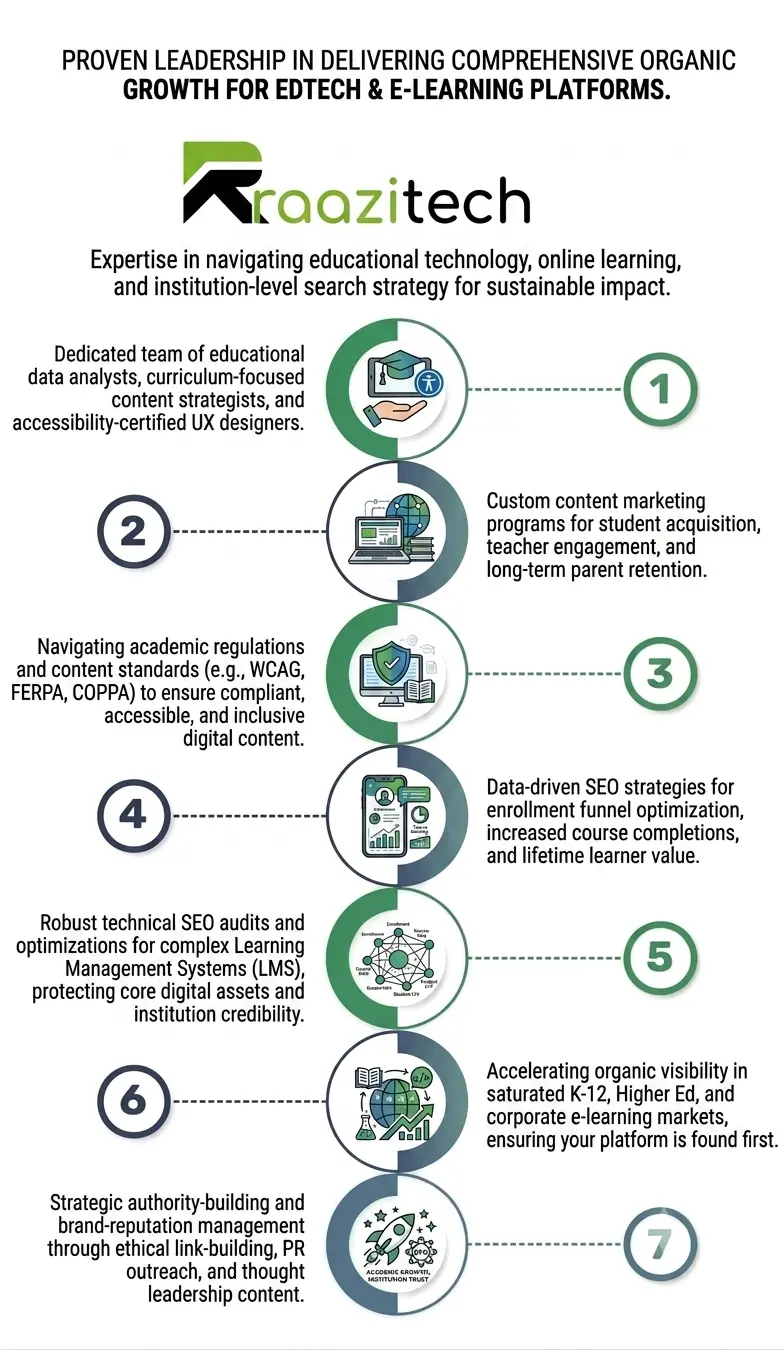
Why EdTech SEO Requires a Different Approach
Procurement Is Institutional and Slow
EdTech deals do not close quickly. A K-12 district evaluation can run six to twelve months and involve a committee, a pilot program, a board vote, and a multi-year contract. An enterprise L&D deal follows a similarly extended cycle. SEO content has to serve the entire evaluation journey, from the first research query to the final vendor justification the procurement team needs to complete the purchase. Generic SaaS content designed for a shorter conversion cycle fails at every institutional touchpoint that matters.
Seasonality Determines Visibility Timing
In EdTech, being visible at the wrong time of year produces far less pipeline than being visible during procurement season. Content that ranks during budget commitment and vendor selection windows delivers substantially better ROI than content that ranks during the summer months when district administrators are not in evaluation mode. We build content calendars that optimize visibility for the specific buying windows of each segment your platform serves.
Multiple Audiences Evaluate the Same Product for Different Reasons
The same EdTech platform is evaluated by teachers for classroom usability, by IT for integration and security, by finance for cost and licensing, and by administrators for curriculum alignment and compliance. Each of these stakeholders searches independently and has different information needs. A single generic page cannot serve all of them. We build multi-stakeholder content architecture that ensures every evaluator finds content built for their specific concerns.
What Our EdTech SaaS SEO Service Covers
EdTech SEO applies core SaaS organic disciplines to the specific procurement realities of educational institutions and corporate learning buyers.
Buyer Segment Differentiation: K-12, Higher Ed, and Corporate L&D
01.
K-12 buyers, higher education administrators, and corporate L&D directors search differently, evaluate on different criteria, and make decisions through different processes. A district technology director researching an LMS uses different language than a university CTO or a Fortune 500 L&D VP. We build separate content paths for each buyer segment so that the administrator entering through a K-12 district keyword lands on content built for district procurement, while the higher education buyer lands on content built for academic governance evaluation. This segmentation produces significantly better qualified traffic than undifferentiated EdTech content.
Seasonal Content and Buying Cycle Alignment
02.
We align content publication and optimization schedules to EdTech procurement seasons. Comparison content, buyer guides, and ROI justification materials are optimized to rank at peak visibility during budget commitment and vendor selection windows. Content that helps institutional buyers build internal business cases, navigate committee evaluation processes, and satisfy board presentation requirements is prioritized in the content roadmap because it serves buyers at the exact moment they are closest to a purchase decision.
Institutional Procurement Content
03.
Educational institutions and corporate L&D departments require specific content to advance a software evaluation through their procurement process. Pilot program specifications, accessibility compliance documentation, LTI and API integration details, data privacy and FERPA or COPPA compliance information, and total cost of ownership frameworks are all content types that directly support institutional buying decisions. We build this content as dedicated pages that capture specific search queries from buyers who are deep in the evaluation process.
Compliance and Standards Alignment Content
04.
EdTech buyers search for software that complies with FERPA for student data privacy, COPPA for children under 13, WCAG accessibility standards, and the specific accessibility requirements of their institution or district. These are not just search terms. They are evaluation gates. Vendors who cannot demonstrate compliance with these standards are eliminated from institutional shortlists regardless of product quality. We build content that addresses each compliance requirement specifically, turning your regulatory posture into a competitive differentiator in organic search.
Comparison and Alternative Pages for EdTech Categories
05.
The 2026 MarTech landscape is moving toward composable architectures where individual modular tools replace monolithic suites. Buyers evaluating composable CDPs, warehouse-native marketing analytics, and API-first automation platforms search using technical architecture terms that generic MarTech content does not address. We build content targeting composable MarTech, warehouse-native CDP, and headless marketing automation searches, capturing the technically sophisticated buyers who are making next-generation MarTech infrastructure decisions.
Comparison and Alternative Pages for EdTech Categories
06.
District administrators and university CTOs are asking ChatGPT and Perplexity for the best LMS platforms, top K-12 digital learning solutions, and leading corporate L&D tools. If your platform does not appear in these AI-generated recommendations, you are missing a growing segment of the early-stage research process. We optimize your content for AI search citation alongside traditional organic rankings, ensuring visibility across all the channels educational buyers use to generate initial shortlists.
What You Receive
Every EdTech engagement starts with a buyer segment audit and seasonal buying cycle mapping before any content production begins.
Buyer segment differentiation strategy covering K-12, higher education, and corporate L&D separately
AI search visibility optimization for educational software discovery queries
Seasonal content calendar aligned to procurement windows, budget cycles, and academic calendars
Compliance keyword research for FERPA, COPPA, WCAG, and institution-specific accessibility requirements
Comparison and alternative page strategy for your specific EdTech sub-category and named competitors
Institutional procurement content plan covering pilot specifications, compliance documentation, and committee evaluation materials
AI search visibility optimization for educational software discovery queries
Ready to start?
Book a free 30-minute discovery call
Frequently Asked Questions
What makes EdTech SEO different from standard SaaS SEO?
EdTech SEO has to account for institutional procurement processes that look nothing like standard SaaS buying. School districts run committee evaluations aligned to academic budget cycles. Universities involve faculty governance and IT oversight. Corporate L&D decisions align to annual planning windows. The buyer is rarely a single person, the sales cycle is measured in months not weeks, and the content that moves evaluations forward is fundamentally different from the conversion-focused content that works in most SaaS categories.
Do you work with all EdTech sub-categories?
We work across the EdTech spectrum including learning management systems, student information systems, assessment and testing platforms, classroom engagement tools, professional development software, corporate learning experience platforms, skills and competency management tools, and educational data analytics. Each sub-category has distinct buyer profiles and procurement dynamics that the strategy addresses.
How do you handle the seasonal nature of EdTech procurement?
We map your target buyer segments to their specific procurement windows and build content calendars that prioritize visibility during peak buying periods. For K-12 in the United States, this means comparison, evaluation, and ROI content should be ranking and driving traffic between January and March and again between June and September. For higher education and corporate L&D, we map the relevant budget commitment and planning cycles and align publication timing accordingly.
How important is compliance content for EdTech SEO?
Compliance content is one of the highest-converting content types in EdTech because it addresses evaluation gates. Buyers searching for FERPA-compliant LMS, COPPA-compliant student tools, or WCAG-accessible educational software are specifically filtering for compliance capability as a prerequisite. Content that addresses these searches directly converts at significantly higher rates than generic feature content because the buyer has already self-qualified on the compliance requirement before they land on your page.
How long does EdTech SEO take to produce results?
Comparison and alternative pages in lower-competition EdTech sub-categories typically show ranking movement within 6 to 10 weeks. Broader educational category content and institutional procurement content that addresses multi-stakeholder evaluation needs takes 3 to 6 months to produce meaningful visibility. Given the extended EdTech procurement cycle, organic-attributed pipeline contribution often takes a full institutional buying season to materialize from first organic touch to closed deal.
Can you help with both B2B institutional EdTech and consumer-facing education tools?
Our focus is B2B EdTech, meaning software sold to school districts, universities, educational publishers, or corporate L&D departments. If your platform serves both institutional buyers and individual educators or students, we build separate content strategies for each audience to prevent keyword dilution and ensure that institutional procurement content reaches decision-makers rather than being mixed with consumer education search traffic.